Neoni® fills critical gap in ledger-based carbon accounting landscape
18 September 2026 — EngagedX Ltd / iSumio
In August 2026, the International Chamber of Commerce and Carbon Measures published The Carbon Accounting Landscape Review, surveying six product-level carbon accounting approaches on the market. It concludes that the field still lacks a widely adopted, ledger-based carbon accounting architecture — the equivalent of GAAP or IFRS for product-level embedded emissions — in which emissions are recorded once at source, allocated to outputs, with data transmitted from seller to buyer, reconciled to entity-level totals, and independently assured.
We welcome the institutional standards and systems interoperability being called for – it is exactly the paradigm shift Neoni® was designed for.
This article chronicles Neoni®'s development from 2019 to commercial launch in 2023 and beyond. It showcases how Neoni® leverages familiar financial accounting logic, the granularity of purchase ledger data, and principles of linked data and the open web.
Neoni® is designed to:
- Meet the most demanding requirements of the Greenhouse Gas (GHG) Protocol
- Align with ISO standards
- Support the statistical rigour of input-output analysis
- Deliver ledger-based carbon accounting
- Meet requirements of the EU's new Carbon Border Adjustment Mechanism (CBAM)
Timeline of Neoni® and other key milestones in developing ledger-based carbon accounting
2019 to early 2021 — methodology and technical incubation
EngagedX initiates technical development of a decentralised carbon accounting framework under the instansOS and instans brands. This is based upon a previous initiative by EngagedX founder Karl H. Richter, whilst working at the United Nations 2017 / 2018 as Head of Research and Knowledge, UNDP SDG Impact Finance (UNSIF), where he develops the 'Internet of Impact' initiative for interoperable impact data sharing across organisations.
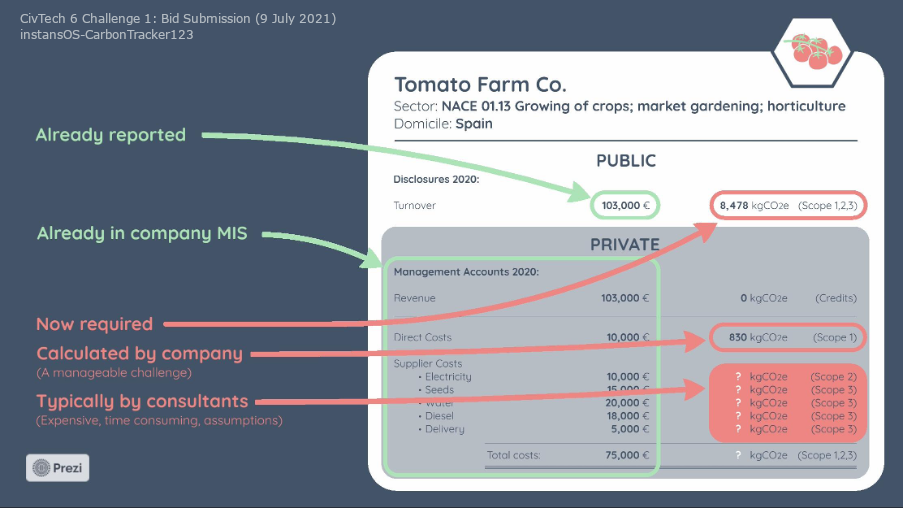
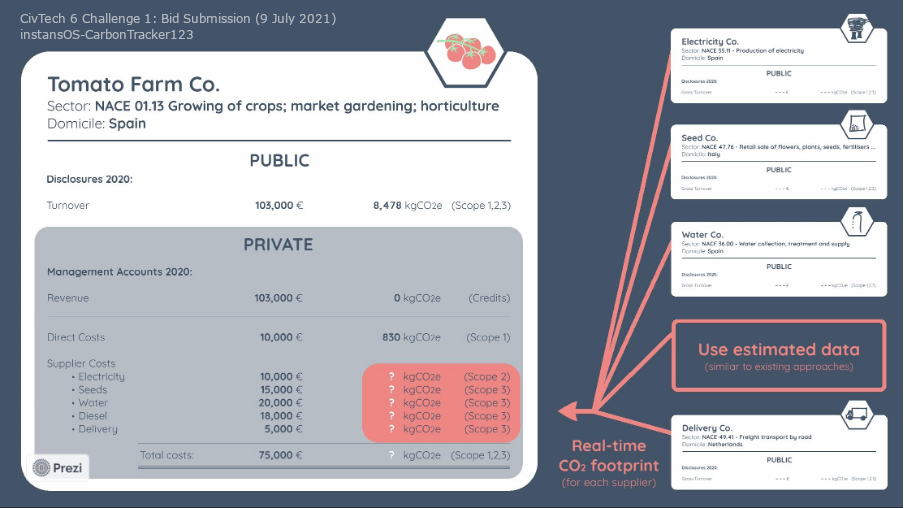
From 2019 EngagedX develops several functional prototypes using distributed web protocols for linked data known as SOLID and developed by Sir Tim Berners-Lee, contributing code to the open-source project to enable near real-time data updating between data pods. EngagedX builds a demonstration prototype app using SOLID protocols, the app is known as CarbonTracker123 (a precursor to Neoni®). The core architecture is designed to ingest underlying corporate purchase ledger data as basis for mapping to suppliers and purchased items. Emissions data are transmitted dynamically from suppliers in the value chain, as soon as the values are updated. Data gaps are augmented with estimated data compliant with the GHG Protocol's spend-based methodology if underlying real-world emissions data are not available from suppliers.
Mid 2021 — public sector innovation winner
EngagedX's transactional accounting-based approach (driven by purchasing ledgers, established manufacturing sector cost allocation logic, and sales ledgers) is selected as a competitive finalist for the Scottish Government's CivTech 6 Challenge 1 innovation accelerator "How can technology help manufacturing businesses decarbonise while building resilience and strengthening competitive advantage?" (public procurement notice ID: JUN418207). The initial bid is submitted by EngagedX by the 9 July 2021 deadline, a letter from the Scottish Government Procurement and Property Directorate dated 21 July 2021 confirms EngagedX acceptance into the accelerator process. EngagedX wins the CivTech challenge and spins out iSumio Ltd as a new Scottish Company with Karl H. Richter and Jenni Inglis as founders (iSumio is later folded back into EngagedX in 2025). A letter from the Scottish Government Procurement and Property Directorate dated 4 August 2021 confirms first financial contract award and passage from Exploration Stage to Accelerator Stage with contract signing dated 30 September 2021. A functional software prototype is demonstrated alongside the "Demo Day" pitch at the end of the CivTech Accelerator Stage 8 Feb 2022.
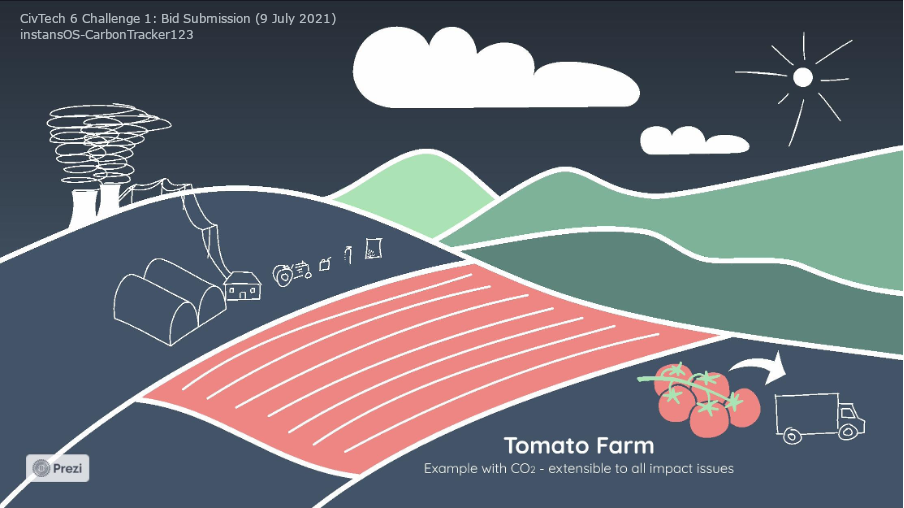
The original bid by EngagedX Ltd / iSumio (9 July 2021) emphasises the need for some parts of the solution to remain open source and a public good (the instansOS open infrastructure for data transmission between entities using linked data protocols) – whilst some parts can be developed as a proprietary and commercial solution (the CarbonTracker123 emissions accounting software, able to interoperate with other comparable solutions). The approach to transmit emissions data through supply chains is guided by a simple maxim: "your company's indirect emissions are another company's direct emissions, just connect the data". The original bid includes the following images demonstrating the ledger-based architecture and intentional design logic familiar to financial accountants, as well as the hybrid approach accommodating both real-world data from suppliers and estimated data if no supplier data are available.
Images from EngagedX / iSumio's initial CivTech bid (9 July 2021)
Late 2021 — E-Liability / E-Ledger framework publication
Professors Robert S. Kaplan (Harvard Business School) and Karthik Ramanna (University of Oxford) publish the "E-Liability" framework in the article "Accounting for Climate Change" in the November/December 2021 issue of the Harvard Business Review (based on the working paper 22-005 "How to Fix ESG Reporting", posted 9 August 2021 on SSRN, ID: 3900146). Professors Kaplan and Ramanna found the E-Liabilities Institute in 2022 and rename it to the E-Ledgers Institute in 2025. Their academic framework, grounded in familiar principles of financial accounting cost allocation and inventory management, provides a method for auditing carbon accounting with the same rigour as financial accounts.
Late 2021 — international showcase at COP26
iSumio is invited by the Scottish Government to showcase their carbon accounting solution at the UN Climate Change Conference (COP26) hosted in Glasgow Scotland. On 3 November 2021 iSumio co-founder Jenni Inglis officially presents the logic and approach of the CarbonTracker123 solution to international delegates alongside Stuart Strachan (Head of Advanced Manufacturing at the Scottish Government). Event images are on social media (Twitter/ X).
Late 2021 — methodology publication for Strategic CO₂ Transparency Tool (SCOTT)
BASF responds to the lack of commercially available product-level carbon accounting solutions, developing an in-house digital tool for calculating product-level emissions. The solution is known as the Strategic CO₂ Transparency Tool (SCOTT), with development led by Professor Peter Saling and Dr Jochen Kurtz at BASF. The company releases cradle-to-gate product carbon footprints (PCFs) for all its approximately 45,000 chemical-based products in 2021 and publishes its methodology on 20 December 2021. BASF initially announces plans in July 2020 for a phased customer rollout of their tool.
Early 2022 — commercial contract execution
iSumio co-founders Karl H. Richter and Jenni Inglis secure a formal commercial government contract (signed 11 February 2022) to construct and deploy the software solution (then still branded as CarbonTracker123). The solution launches as Neoni® in March 2023 for functional use with manufacturing companies and their suppliers (early releases were codenamed "Neoni® Aurora" and "Neoni® Borealis"). The Neoni® platform demonstrates that it is feasible to integrate recursive calculations based on the transmission of real-world supply chain data between entities. For full compatibility and fallback functionality, Neoni® is able to fill any data gaps by integrating average emissions data if required, using the GHG Protocol's spend-based methodology, to seamlessly complete the analysis of upstream indirect emissions for a comprehensive cradle-to-gate emissions footprint.
Mid 2022 (with notable precursors 1970, 2009, 2010, 2019, 2021) — input-output analysis as statistical validation
Input-output models – a well-established macroeconomic statistical tool – are developed in the 1930s-1940s (widely credited to Wassily Leontief). Leontief subsequently suggests this technique could also be applied to environmental metrics in a 1970 paper “Environmental Repercussions and the Economic Structure: An Input-Output Approach”, which applies input-output analysis to air pollution (carbon monoxide) and environmental issues.
Professor Mike Berners-Lee (Lancaster University) applies input-output models to emissions analysis in his 2009 book "How bad are bananas?: The Carbon Footprint of Everything". In 2010 Berners-Lee and colleagues write the paper "Greenhouse gas footprinting for small businesses — The use of input–output data" (available online 22 December 2010). As Berners-Lee's consultancy, Small World Consulting, later explains, input-output models "solve the problem of incomplete system boundaries" and the "truncation error" inherent in traditional life-cycle assessment (which can only trace a finite number of supply chain tiers), but sacrifice specificity, providing only industry-average emissions factors rather than data for a particular supplier or product. Berners-Lee advocates a hybrid model: life-cycle assessment data for supply chain tiers where specific supplier or product data is available, and input-output data to fill the remaining, untraced tiers, completing the system boundary without discarding the precision available from measured tiers.
Dr Ulf von Kalckreuth, Principal Economist-Statistician at the Deutsche Bundesbank, publishes research demonstrating how statistical methods can improve emissions measurement when applied interatively through successive supply chains tiers. Von Kalckreuth first corresponds internally with Bundesbank colleagues about the idea on 13 September 2019, before presenting it more widely internally on 11 March 2021, and formally on 15 September 2021 at the International Conference on Statistics for Sustainable Finance (organised by Banque de France, Deutsche Bundesbank, and the Irving Fisher Committee on Central Banking Statistics), von Kalckreuth published a discussion paper 23/2022 in June 2022 “Pulling ourselves up by our bootstraps: the greenhouse gas value of products, enterprises and industries”. Von Kalckreuth identifies a critical gap: "the link between direct and indirect emissions is not trivial … the measurement of indirect emissions in the GHG Protocol tradition is largely ad hoc and dissociated from the well-established measurement of direct emissions." Subsequent research by von Kalckreuth, including BIS IFC Working Paper No. 24 (2024) and a 2025 publication in the Latin American Journal of Central Banking, demonstrates how recursive calculations allow emissions estimates to converge toward accurate values across supply chain tiers, with the convergence rate and data depth requirements varying by industry heterogeneity.
Late 2022 — corporate carbon accounting: balance sheets and flow statements
Professor Stefan Reichelstein introduces a transactional paradigm that incorporates double-entry bookkeeping into carbon accounting. Modelled on the stocks and flows of classic financial accounting, his discussion paper 22-052 "Corporate Carbon Emission Statements", posted 8 November 2022, shows how an entity’s carbon footprint can be mapped onto a carbon balance sheet, following familiar templates for financial accounting statements. Professor Reichelstein founds the Carbon Accounting Standards Initiative (CASI) with Dr Christoph Ernst and colleagues to promote the development of these principles as Integrated Corporate Carbon Accounting (ICCA).
Early 2023 — engagement with the E-Ledgers Institute
iSumio co-founder Karl H. Richter initiates a communication with the E-Ledgers Institute and Professor Karthik Ramanna to discuss methodological alignment and system interoperability with the E-Ledger approach. Richter introduces Neoni® as a software solution that already applies an analogous approach in practice, and is invited by the E-Ledgers team to contribute towards their Proto-Standard for Carbon Accounting and Auditing using the E-Liability Method, first published in 2024.
Mid 2023 — SAP Green Ledger
On 17 May 2023, SAP announces its plans for Green Ledger, a ledger-based carbon accounting module applying double entry bookkeeping for emissions, integrated with the financial systems and enterprise resource planning (ERP) solutions SAP provides to corporations. Development is generally credited to Mike Szabo, Bastian Distler, Christoph Ehrhardt, and Dr Christoph Ernst of SAP. Green Ledger reaches general availability on 16 December 2024, embedding the ledger-based approach directly within existing business workflows for large enterprises already running SAP systems.
—
Taken together, this chronology shows six independent teams — EngagedX / iSumio (from 2019), von Kalckreuth (from 2019), BASF (from 2020), Kaplan and Ramanna (from 2021), Reichelstein (from 2022), and SAP (from 2023) — arriving at the same ledger-based carbon accounting logic from five distinct vantage points: a startup innovator building the software from first principles (EngagedX / iSumio), central bank macroeconomic statistics (von Kalckreuth), a multinational manufacturing company quantifying its product portfolio (BASF), academic accounting theory (Kaplan and Ramanna; Reichelstein), and an established enterprise vendor retrofitting it into existing ERP infrastructure (SAP). None credits the others as the origin of their approach. Independent convergence of this kind is mutually validating and strong evidence of a sound underlying principle, more than any single endorsement could provide.
The Bank for International Settlements' own October 2024 report “Empowering carbon accounting: from data to action” independently notes this pattern, citing EngagedX / iSumio's software alongside Jérôme Cazes's “Carbones sur factures” initiative in France as cumulative, e-liability-like accounting approaches arrived at separately in different countries. Cazes's approach, like Dr Björn Holste and Dr Marcus Cramer's earlier 2020 proposal in Germany to print a shopping basket's carbon footprint directly onto the till receipt, demonstrates a practical, real-world way to communicate emissions data from supplier to customer using conventional commercial mechanisms — invoices and receipts — without requiring interconnected software systems.
System architecture and interoperability
Neoni® occupies a distinct and necessary position within this landscape. Enterprise systems such as SAP Green Ledger presuppose that suppliers already run comparable ERP infrastructure. Most large multinational suppliers do. Most small and micro-enterprises do not, and are unlikely to adopt such systems given their cost and complexity. Since indirect emissions data can only cascade through a supply chain as far as its least-equipped participant allows, this gap is material: it is precisely at the level of small suppliers that ledger-based carbon accounting is most at risk of breaking down. Neoni® is purpose-built to close it, providing ledger-based carbon accounting rigour to micro-entities and small businesses that would otherwise be excluded. Deployed alongside SAP Green Ledger or equivalent systems, Neoni® extends end-to-end ledger coverage across a supply chain of any composition, from multinationals to micro-enterprises, and across sectors from manufacturing to financial services.
Neoni®'s architecture is built to solve the underlying data problem common to all these initiatives: obtaining reliable, granular data on indirect emissions buried within multiple tiers of a value chain, and transmitting it as auditable climate metrics between organisations. To protect commercially sensitive and proprietary information, Neoni® generates and transmits anonymised intensity ratios rather than raw supplier data, avoiding any need for the cryptography, hashing, or blockchain infrastructure that some Web 3.0-inspired proposals assume are necessary. This achieves data privacy by design: supplier trade secrets and information about corporate margins remain fully protected, while compliance, auditability, and statistical rigour are preserved. The architecture is designed for native interoperability with the GHG Protocol, ISO standards, guidance from the Partnership for Carbon Accounting Financials (PCAF), CBAM requirements, and E-Ledger principles, functioning as a bridge between the large-enterprise systems of SAP and corporate accountants, the macroeconomic rigour demanded by central bank statisticians, and the day-to-day reality of small and micro-suppliers who make up most of the world's supply chains.
Positioning Neoni® within the ledger-based carbon accounting landscape
The Carbon Accounting Landscape Review examined six product-level carbon accounting approaches:
- the Greenhouse Gas (GHG) Protocol Product Standard (flexible but methodologically inconsistent across suppliers)
- ISO 14067 (the international standard, built on life-cycle assessment)
- the EU's Product Environmental Footprint (prescriptive, category-specific rules)
- International Sustainability and Carbon Certification (ISCC)'s Carbon Footprint Certification (strong on primary data and third-party verification)
- the Partnership for Carbon Transparency (PACT) (digital infrastructure for multi-tier supply chains)
- the E-Ledgers / E-Liability proto-standard (early-stage but most directly aligned with the identified gap)
Neoni® closes the gap: a production-grade ledger-based carbon accounting solution – proven with manufacturing companies and their suppliers since March 2023. While the E-Ledgers proto-standard remains early-stage operationally, Neoni® demonstrates that emissions recorded at source from purchase ledgers, allocated to outputs, transferred as accountable quantities between supplier and customer, reconciled to entity-level totals, and auditable to financial standards is not just theory – it works at scale, years ahead of the standard-setting process now underway.
© 2026 EngagedX Ltd and iSumio. All rights reserved.
For verified logs and documentation, visit: neoni-app.com | engagedx.com | instans.net | isum.io | internetofimpact.org | karlhrichter.com