Features
Neoni® achieves the most demanding requirements of the Greenhouse Gas (GHG) Protocol. Use Neoni® to comply with ISO standards, Science Based Targets initiative (SBTi), Partnership for Carbon Accounting Financials (PCAF), and the E-Ledger principles.
Basic
Free
- Easily prepare carbon accounts
- Share data with your customers who use Neoni®
- Improve the accuracy of your accounts by inviting your suppliers to use Neoni®
Standard
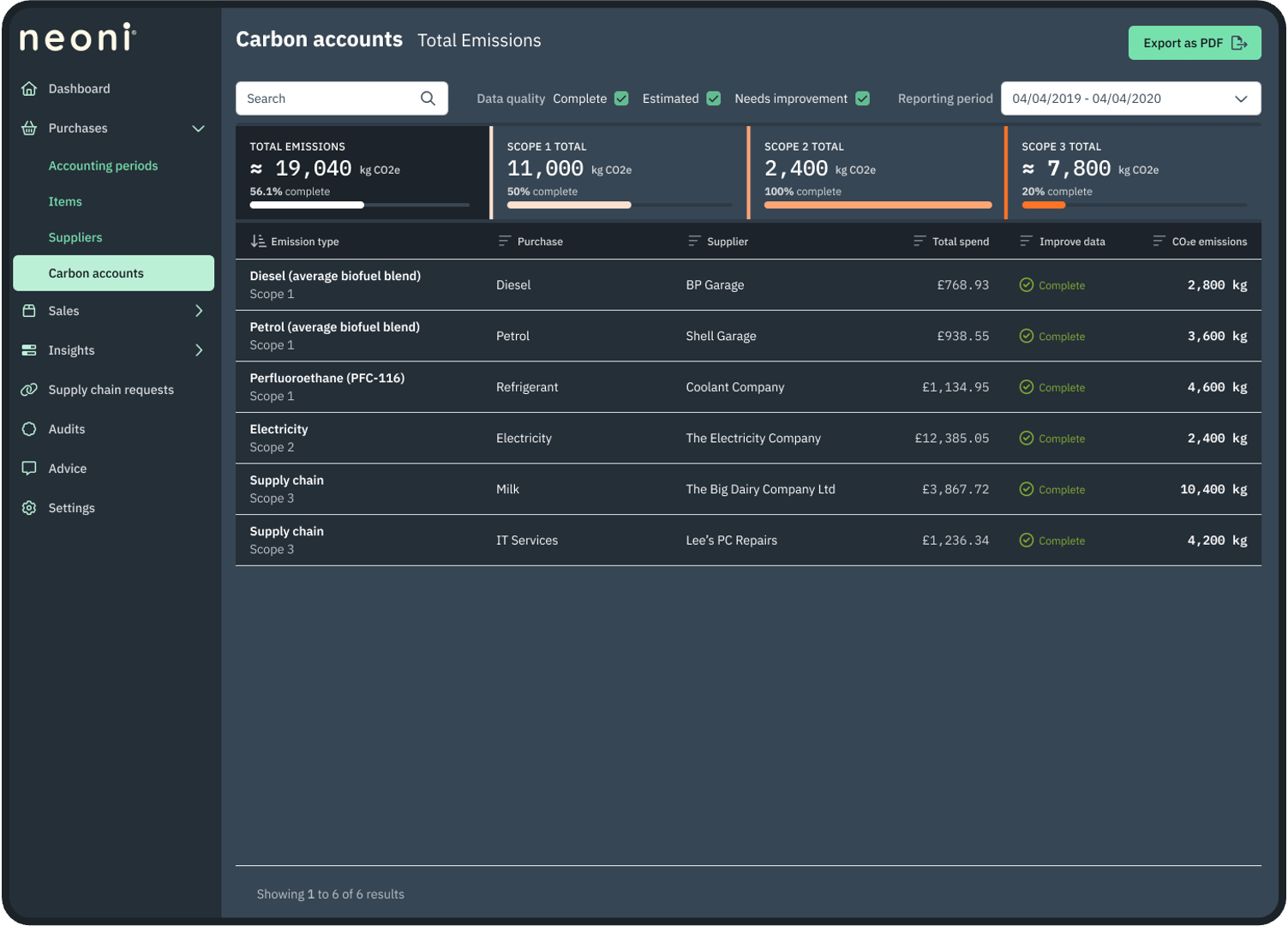
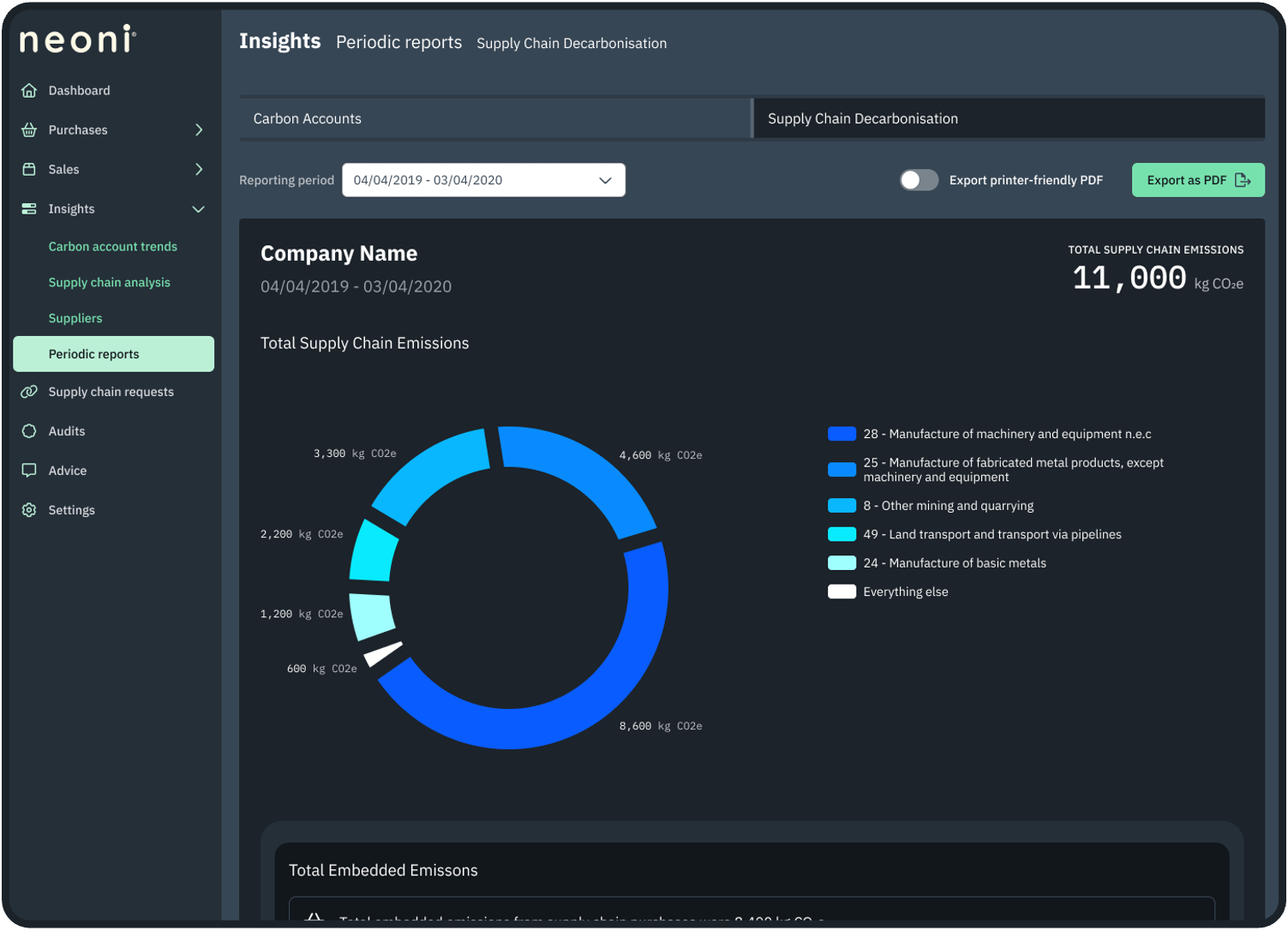
- View reports and dashboards
- Publish progress to 3rd parties
- Satisfy minimum compliance and disclosure requirements
Premium
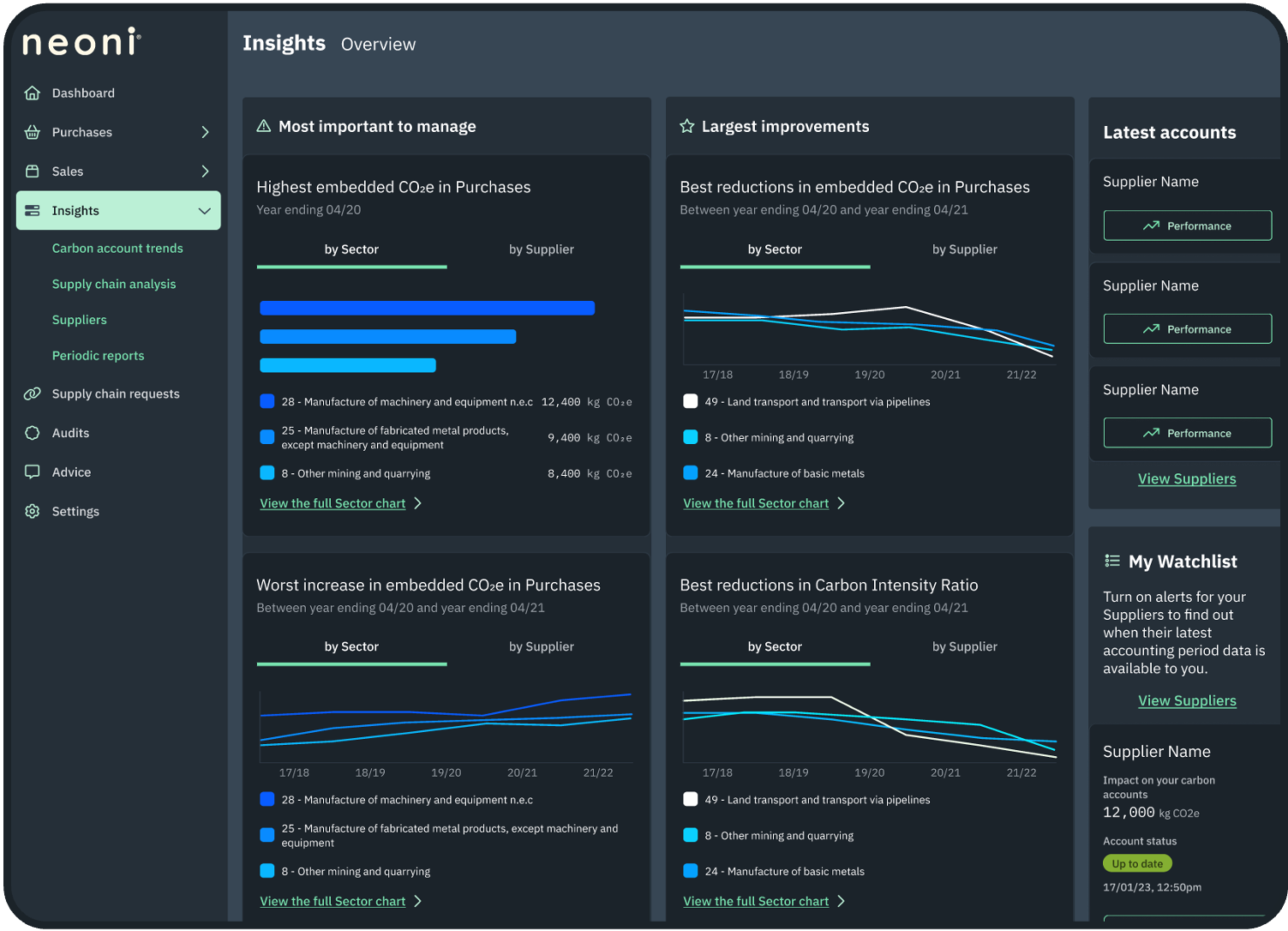
- Get advanced insights about your specific suppliers and product lines
- Inform actions that are most effective to decarbonise your operations
Standards alignment
Use Neoni® to produce ledger-based emissions accounts that are auditable like financial accounts with the statistical rigour required for macroeconomic analysis and input-output models – all whilst achieving the most demanding requirements of GHG Protocol and complying with ISO Standards, SBTi, PCAF, and E-Ledger principles.

In the scenario above:
- A company manufactures 4,000 units of product in a period, of these 3,200 are sold and 800 remain unsold in the warehouse.
- Upstream emissions (according to the GHG Protocol/ ISO, highlighted in orange) are 40,000 tCO2e and represent the 4,000 units manufactured in total this period. 32,000 tCO2e represent the 3,200 units sold (according to E-Ledger principles, highlighted in green).
- Each unit has 10 tCO2e of the company’s total emissions allocated to it (this is the same according to both GHG Protocol/ ISO and E-Ledger principles) and can be assigned to products via invoices or digital product passports (DPPs).
- The E-Ledger records 8,000 tCO2e of retained emissions as a separate line unit, which represent the 800 unsold units remaining in the warehouse. Until sold, these units remain in the possession of the manufacturing company and on their balance sheet as inventory (both in terms of financial cost and emissions liability).
- Full life cycle assessment (LCA) values are presented as a range, because downstream emissions from using products are typically uncertain depending on the use-case. The full LCA range is between 15 tCO2e and 30 tCO2e per unit, respectively between 60,000 tCO2e and 120,000 tCO2e across all units manufactured in the period.